Artificial intelligence has evolved far beyond answering questions or generating text.
Today’s AI systems can plan tasks, make decisions, interact with software, browse the web, analyze information, and complete complex workflows with little or no human intervention. These advanced systems are known as AI agents.
From automating customer support and scheduling meetings to conducting market research and writing code, AI agents are transforming how businesses and individuals work.
Instead of waiting for step-by-step instructions, they can understand goals, create plans, use external tools, and adapt based on new information.
Whether you’re a business owner looking to automate repetitive tasks or simply curious about the future of AI, understanding AI agents is becoming increasingly important.
In this guide, you’ll learn:
- What an AI agent is
- How AI agents work
- Different types of AI agents
- AI agent examples
- AI agent vs chatbot
- AI agent vs AI assistant
- Benefits and limitations
- Popular AI agent tools
- How businesses are using AI agents
By the end of this article, you’ll have a clear understanding of how AI agents work and why they are considered the next major evolution in artificial intelligence.
What Is an AI Agent?
An AI agent is an intelligent software system that can perceive information, understand objectives, make decisions, and take actions to achieve a specific goal with minimal human intervention.
Unlike traditional AI tools that simply respond to prompts, AI agents can independently decide what to do next, which tools to use, and how to complete a task.
Think of an AI agent as a highly capable digital employee rather than a chatbot.
For example, if you ask an AI chatbot:
“Write a marketing email.”
It generates the email.
However, if you ask an AI agent:
“Launch an email campaign for my new product.”
The AI agent can:
- Research your product
- Identify your target audience
- Write the email
- Design the campaign
- Schedule it
- Track performance
- Recommend improvements
All of this happens as part of a single goal.
This ability to plan, reason, and execute multiple steps makes AI agents significantly more powerful than conventional AI applications.
Our service: AI Agent Developement
AI Agent Definition
An AI agent is an autonomous software system powered by artificial intelligence that observes its environment, reasons about the best course of action, uses available tools, and performs tasks to achieve predefined goals.
Simple Everyday Example
Imagine planning a vacation.
Instead of manually:
- Searching flights
- Comparing hotels
- Reading reviews
- Creating an itinerary
- Booking transportation
An AI agent could handle the entire process for you.
It searches multiple travel websites, compares prices, checks weather forecasts, builds a personalized itinerary, and presents the best options—all while considering your preferences.
This is what makes AI agents different from ordinary AI assistants.
Key Characteristics of an AI Agent
- Goal-oriented
- Autonomous
- Context-aware
- Uses reasoning
- Plans multiple steps
- Learns from feedback
- Integrates with external tools
- Automates workflows
Why Are AI Agents Becoming So Popular?
Businesses generate enormous amounts of data every day, yet employees often spend hours on repetitive tasks such as responding to emails, updating spreadsheets, researching information, and preparing reports.
AI agents help automate these processes.
Several technological advancements have accelerated their adoption:
More Powerful Large Language Models
Modern AI models understand language with remarkable accuracy and can reason through complex problems.
Better Tool Integration
AI agents can connect with CRMs, email platforms, databases, cloud storage, calendars, and business applications.
Improved Memory
Many AI agents remember previous interactions, allowing them to personalize responses and continue long-running tasks.
Workflow Automation
Instead of performing isolated tasks, AI agents complete entire workflows from start to finish.
Industries Adopting AI Agents
AI agents are already being used in:
- Customer support
- Sales
- Marketing
- Healthcare
- Finance
- Education
- Human Resources
- Software development
- Legal services
- Manufacturing
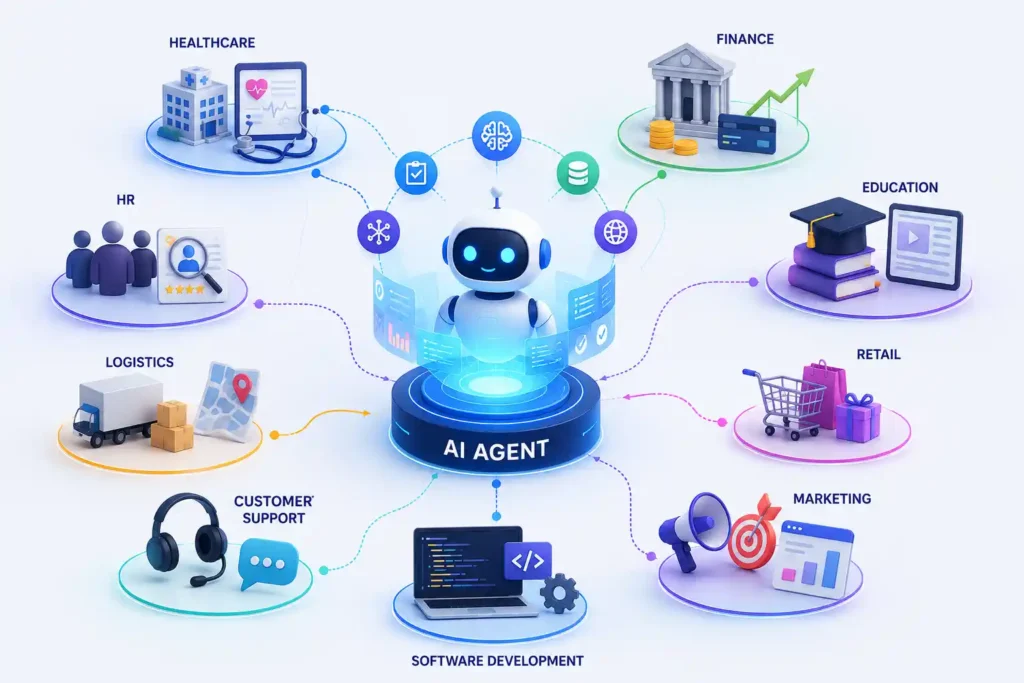
As AI technology advances, these agents are expected to become an essential part of nearly every business operation.
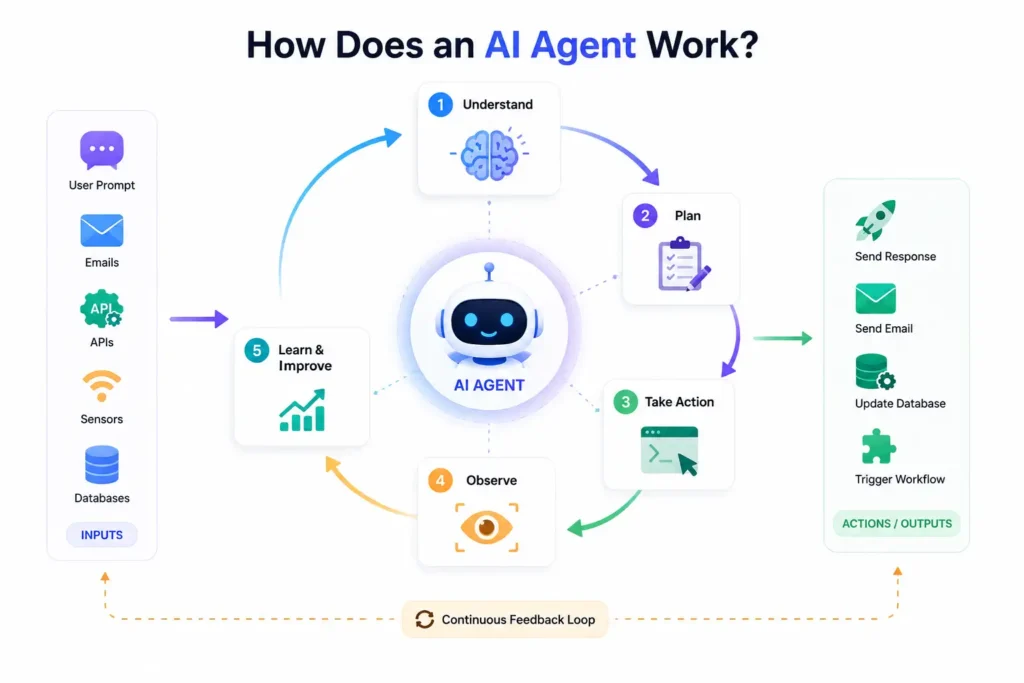
How Does an AI Agent Work?
At a high level, AI agents follow a structured process to complete tasks efficiently.
Instead of simply generating an answer, they continuously analyze information, make decisions, and execute actions.
Here’s how the process typically works.
Step 1: Receive Input
Every AI agent begins by receiving information.
This may come from:
- User instructions
- Voice commands
- Sensors
- APIs
- Databases
- Emails
- Business software
For example:
“Find the top five competitors for my business and prepare a report.”
The AI agent interprets this as its objective.
Step 2: Understand the Goal
Next, the AI agent identifies:
- The user’s intent
- Required outcome
- Constraints
- Available resources
Rather than focusing only on keywords, modern AI agents interpret context.
For instance:
“Book the cheapest flight arriving before noon.”
The AI agent understands both the budget constraint and the arrival time requirement.
Step 3: Create a Plan
After understanding the objective, the AI agent breaks it into smaller tasks.
For example:
Task:
“Create an SEO strategy.”
Possible plan:
- Research keywords
- Analyze competitors
- Audit website
- Generate content ideas
- Build a publishing calendar
- Recommend backlink opportunities
Planning enables AI agents to solve complex problems systematically.
Step 4: Use External Tools
AI agents become significantly more powerful when they interact with external systems.
Common tools include:
- Search engines
- Web browsers
- CRM software
- Calendars
- Email platforms
- Databases
- Spreadsheets
- APIs
- Project management tools
For example, a sales AI agent might:
- Search LinkedIn
- Find potential leads
- Enrich contact information
- Draft personalized emails
- Update the CRM automatically
Step 5: Execute Actions
Once the plan is ready, the AI agent performs the required actions.
Examples include:
- Sending emails
- Creating reports
- Writing content
- Scheduling meetings
- Running automations
- Updating databases
- Generating code
- Booking appointments
Unlike traditional AI systems, AI agents can execute these actions without requiring constant user supervision.
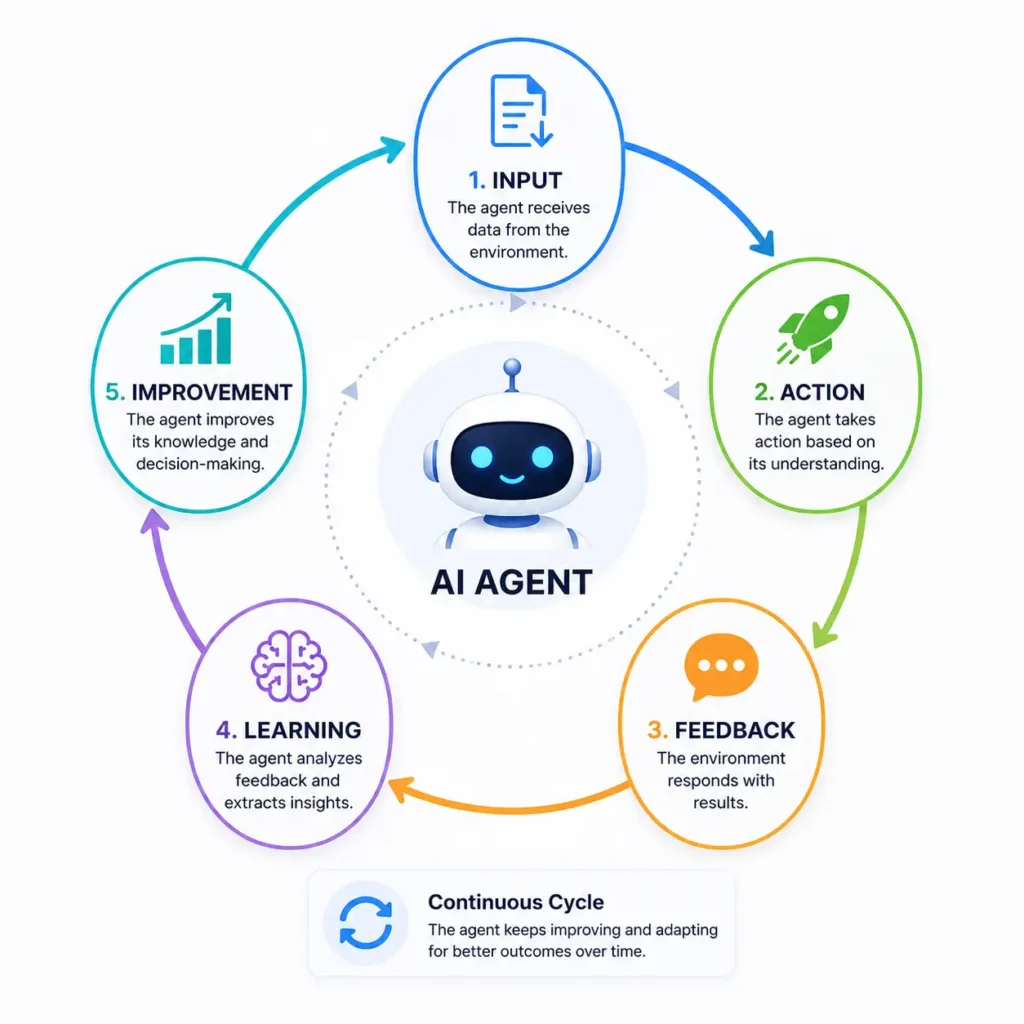
Step 6: Learn and Improve
Many AI agents continuously improve by learning from:
- Previous conversations
- User preferences
- Feedback
- Task outcomes
- Performance metrics
This allows future decisions to become more accurate and personalized.
For example, if you consistently prefer concise reports, the AI agent may automatically generate shorter summaries in future interactions.
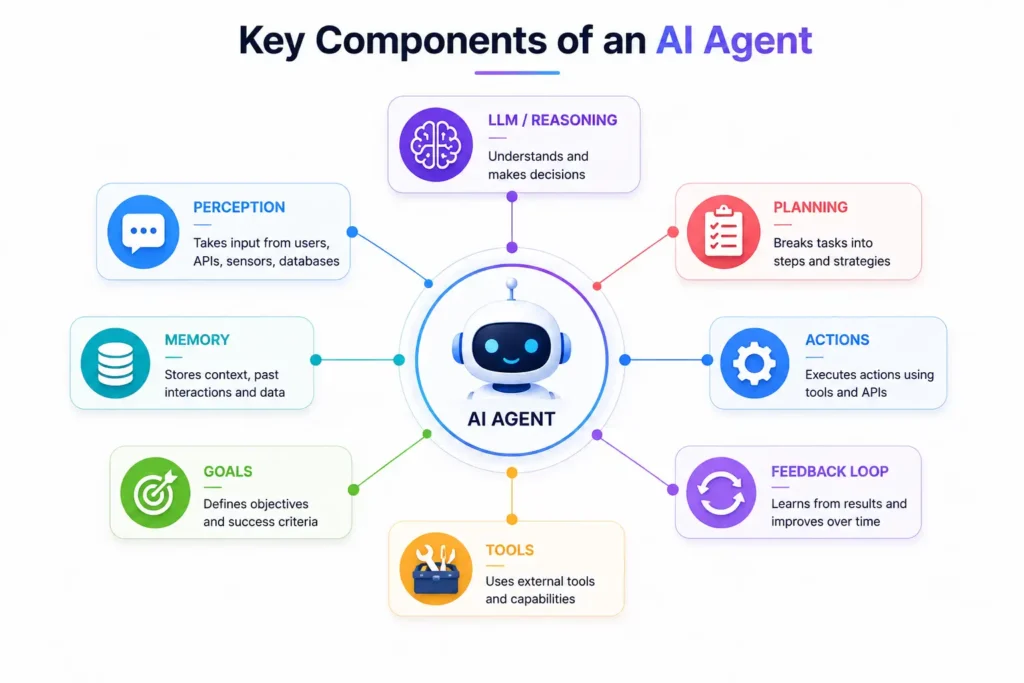
Key Components of an AI Agent
An AI agent is more than just a language model. It’s a combination of multiple components working together to understand goals, make decisions, and complete tasks.
Think of it like a human employee:
- The brain processes information.
- Memory recalls past experiences.
- Planning organizes tasks.
- Tools help complete the work.
- Decision-making chooses the best action.
Without these components, an AI agent would simply generate responses instead of performing meaningful work.
1. AI Model (The Brain)
At the core of every AI agent is a powerful AI model, often called a Large Language Model (LLM).
This model enables the agent to:
- Understand natural language
- Answer questions
- Analyze documents
- Write content
- Solve problems
- Generate code
- Reason through complex tasks
The AI model acts as the “brain” that interprets instructions and decides what to do next.
Example
A customer asks:
“My internet isn’t working.”
Instead of replying with a generic answer, the AI model understands the issue and determines the appropriate troubleshooting steps.
2. Memory
Memory enables AI agents to remember information across interactions.
Instead of starting from scratch every time, the agent can retain useful context.
Memory may include:
- Previous conversations
- User preferences
- Completed tasks
- Business rules
- Long-term project information
Example
If you always prefer reports in PDF format, the AI agent remembers this preference and automatically generates PDFs in future tasks.
Benefits of Memory
- Personalized responses
- Better continuity
- Improved accuracy
- Less repetitive input
- Smarter automation
3. Planning Engine
Planning is what separates AI agents from ordinary chatbots.
Instead of completing one instruction at a time, AI agents create a roadmap before acting.
For example:
Goal:
“Launch a product.”
The planning engine may automatically create tasks such as:
- Research competitors
- Create landing page
- Write blog post
- Design social media campaign
- Prepare email marketing
- Schedule launch
This structured planning helps AI agents solve larger and more complex problems.
4. Decision-Making Engine
After creating a plan, the AI agent decides what action should happen next.
Decision-making depends on:
- Available information
- Current progress
- User instructions
- Business rules
- Previous results
Example
If a website is unavailable during research, the AI agent may automatically choose another trusted source instead of stopping.
This adaptability makes AI agents far more useful in real-world situations.
5. Tool Integration
Modern AI agents can connect with external applications and services.
Common integrations include:
- Search engines
- Email platforms
- Google Workspace
- Microsoft Office
- CRM systems
- Slack
- GitHub
- Calendars
- Payment systems
- Databases
- APIs
Rather than simply answering questions, AI agents can actually perform tasks inside these systems.
Example
A marketing AI agent can:
- Retrieve website analytics
- Analyze keyword rankings
- Generate reports
- Email stakeholders
- Update project management software
All automatically.
6. Communication Interface
Users interact with AI agents through different interfaces, including:
- Chat
- Voice
- Mobile apps
- Websites
- APIs
- Messaging platforms
- Smart devices
The communication interface ensures users can easily give instructions and receive updates.
Types of AI Agents
Not all AI agents work the same way.
Some follow simple rules, while others learn from experience and make complex decisions.
Here are the main types of AI agents.
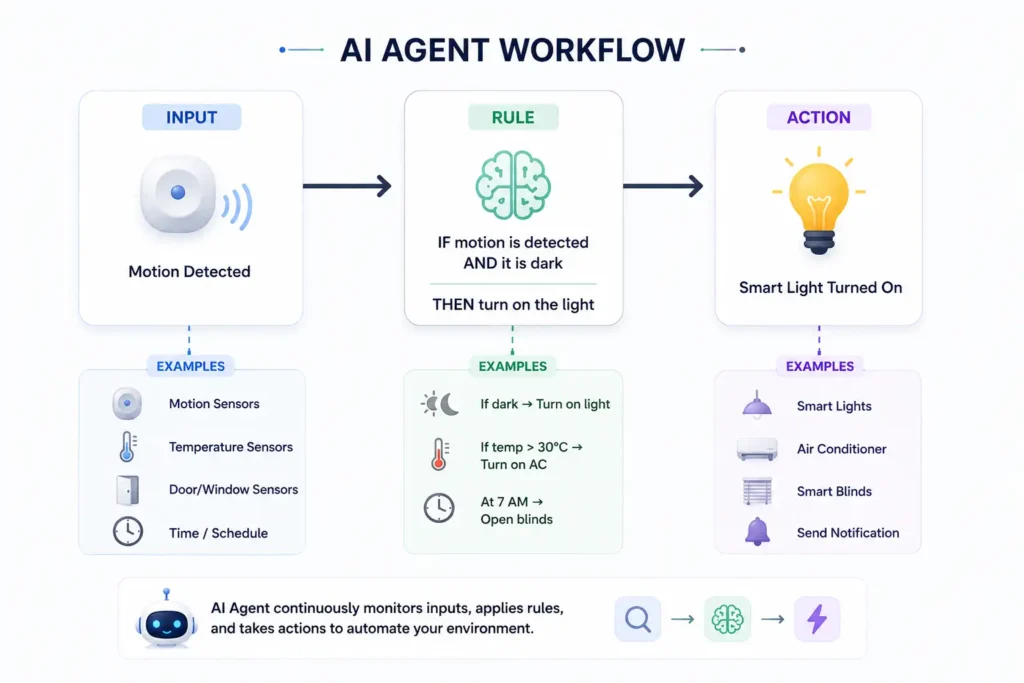
1. Simple Reflex Agents
Simple reflex agents respond directly to current inputs using predefined rules.
They do not remember previous events.
Example
A smart thermostat turns on the air conditioner when the room temperature exceeds a set limit.
Best For
- Basic automation
- Rule-based systems
- Predictable environments
2. Model-Based Agents
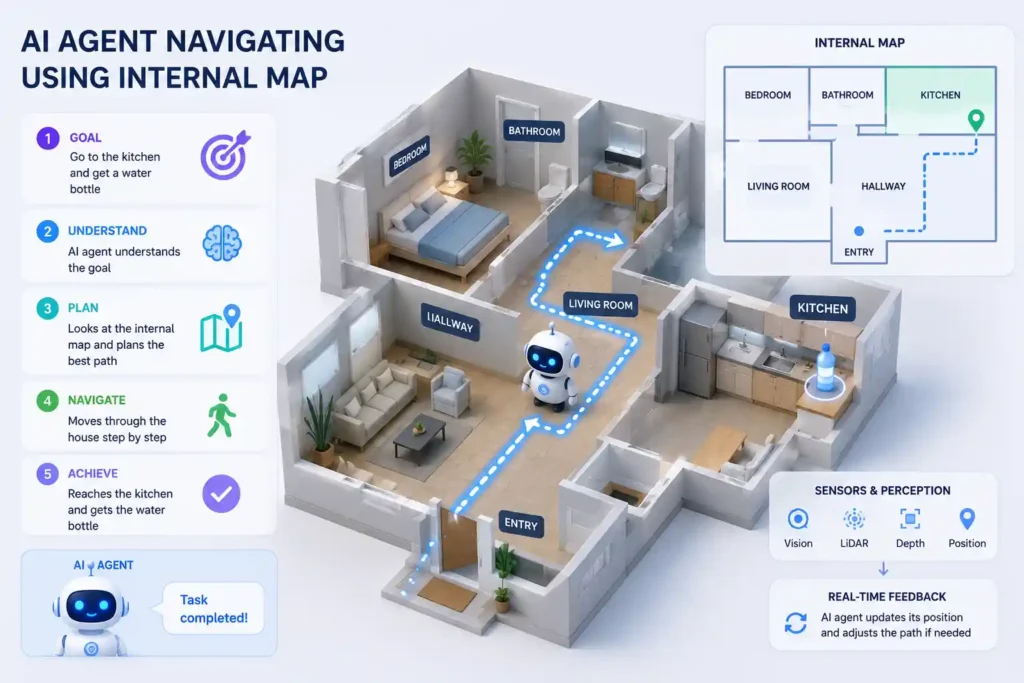
These agents maintain an internal model of the environment.
Instead of reacting blindly, they consider past and present information before acting.
Example
A robot vacuum remembers which rooms have already been cleaned.
3. Goal-Based Agents
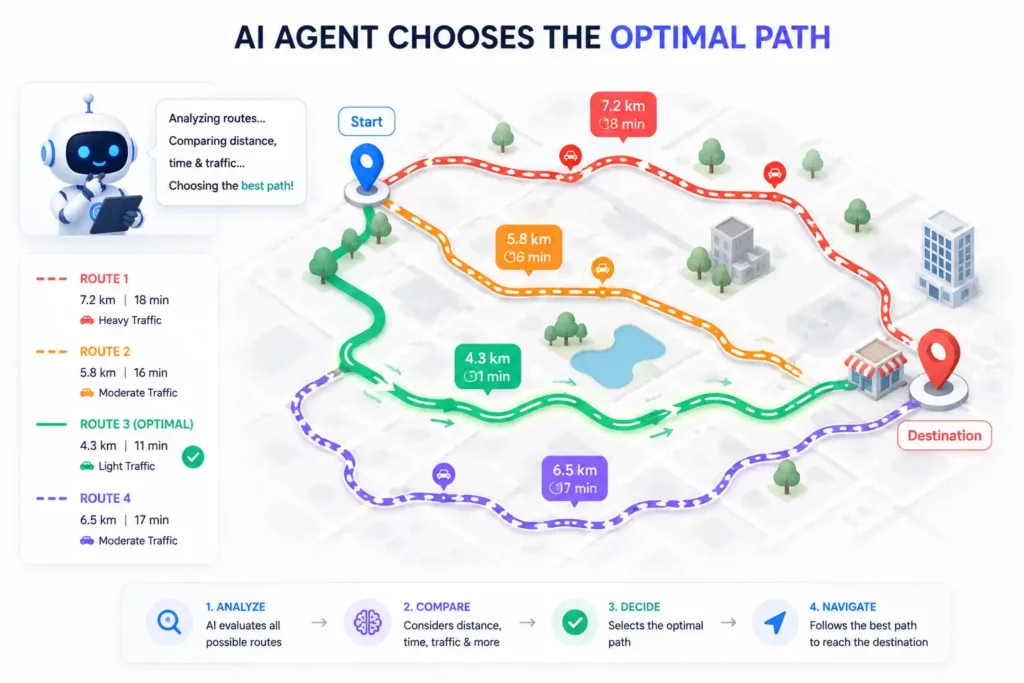
Goal-based agents evaluate different options before choosing the one that best achieves a specific objective.
Example
A navigation app selects the fastest route based on traffic conditions.
Benefits
- Better decision-making
- Flexible planning
- Adaptable behavior
4. Utility-Based Agents
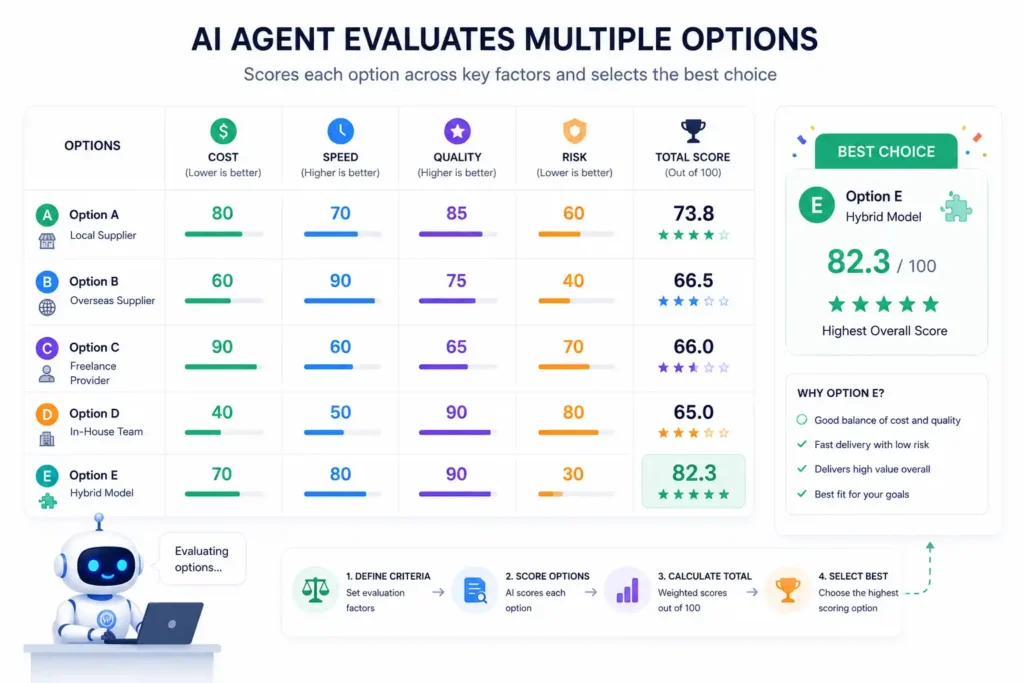
These agents compare multiple possible outcomes and select the option that provides the highest overall benefit.
Instead of asking:
“Can I complete this task?”
They ask:
“Which option gives the best result?”
Example
An investment AI chooses the portfolio offering the best balance between risk and return.
5. Learning Agents
Learning agents improve over time using experience and feedback.
They continually become smarter as they process more information.
Example
Recommendation systems on streaming platforms improve suggestions based on your viewing history.
Key Features
- Learns from mistakes
- Adapts to user behavior
- Improves accuracy
- Evolves continuously
6. Autonomous AI Agents
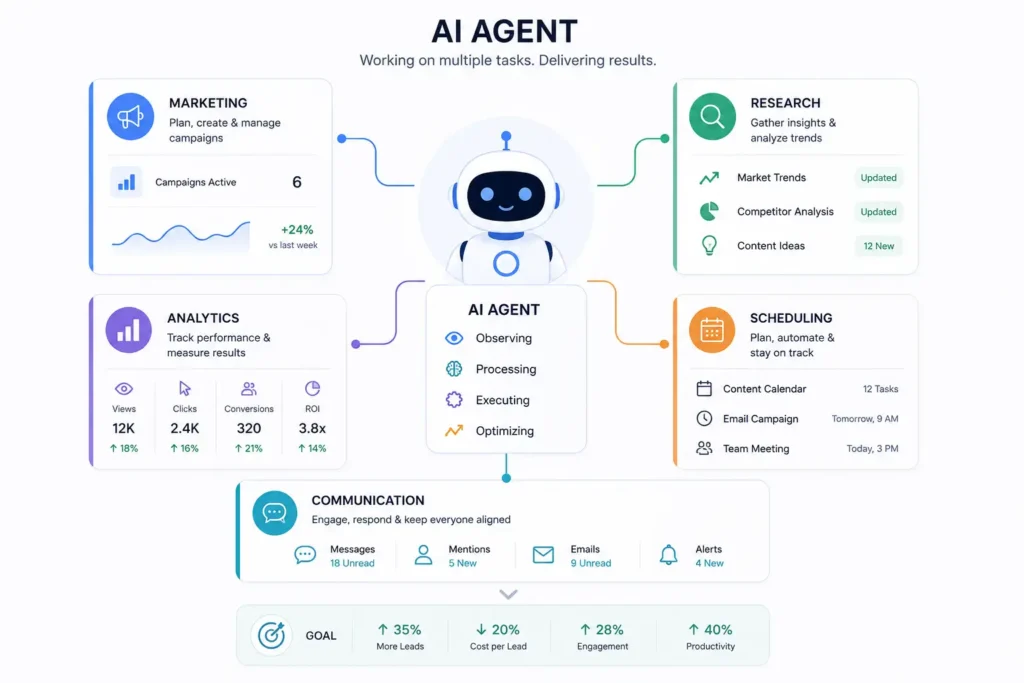
Autonomous AI agents combine planning, reasoning, memory, and tool usage to complete complex tasks with minimal human involvement.
These are the most advanced AI agents available today.
Example
An autonomous marketing agent can:
- Research competitors
- Generate content
- Schedule social media posts
- Analyze campaign performance
- Recommend improvements
without requiring manual intervention after receiving the initial goal.
AI Agent vs AI Assistant
Although the terms are often used interchangeably, AI agents and AI assistants serve different purposes.
| Feature | AI Assistant | AI Agent |
|---|---|---|
| Primary Role | Responds to user requests | Achieves user goals |
| Behavior | Reactive | Proactive |
| Planning | Limited | Multi-step planning |
| Decision-Making | Minimal | Advanced |
| Tool Usage | Limited | Extensive |
| Workflow Automation | Basic | End-to-end |
| Memory | Often session-based | Short-term and long-term |
| Human Supervision | Frequent | Minimal |
| Example | Virtual assistant answering questions | AI system managing an entire project |
In Simple Terms
An AI assistant helps you perform tasks.
An AI agent can perform the tasks for you.
AI Agent vs Chatbot
Many people assume AI agents are just advanced chatbots, but there are major differences.
| Feature | Chatbot | AI Agent |
|---|---|---|
| Conversations | Yes | Yes |
| Planning | No | Yes |
| Memory | Limited | Extensive |
| Uses External Tools | Rarely | Frequently |
| Decision-Making | Basic | Advanced |
| Automation | Limited | End-to-end |
| Multi-Step Tasks | No | Yes |
| Works Independently | No | Yes |
Example
Chatbot
Customer:
“Where is my order?”
Chatbot:
“Please enter your tracking number.”
AI Agent
Customer:
“Where is my order?”
AI agent:
- Finds the order automatically
- Checks shipping status
- Detects delays
- Contacts the courier if needed
- Updates the customer
- Creates a support ticket if required
The AI agent completes the entire workflow instead of only responding.
Benefits of AI Agents
AI agents are changing the way businesses and individuals work by automating repetitive tasks, improving decision-making, and increasing productivity. Unlike traditional software that requires constant user input, AI agents can analyze information, make decisions, and execute workflows with minimal supervision.
Whether you’re a startup founder, marketer, developer, or enterprise leader, AI agents can help you save time and focus on higher-value work.
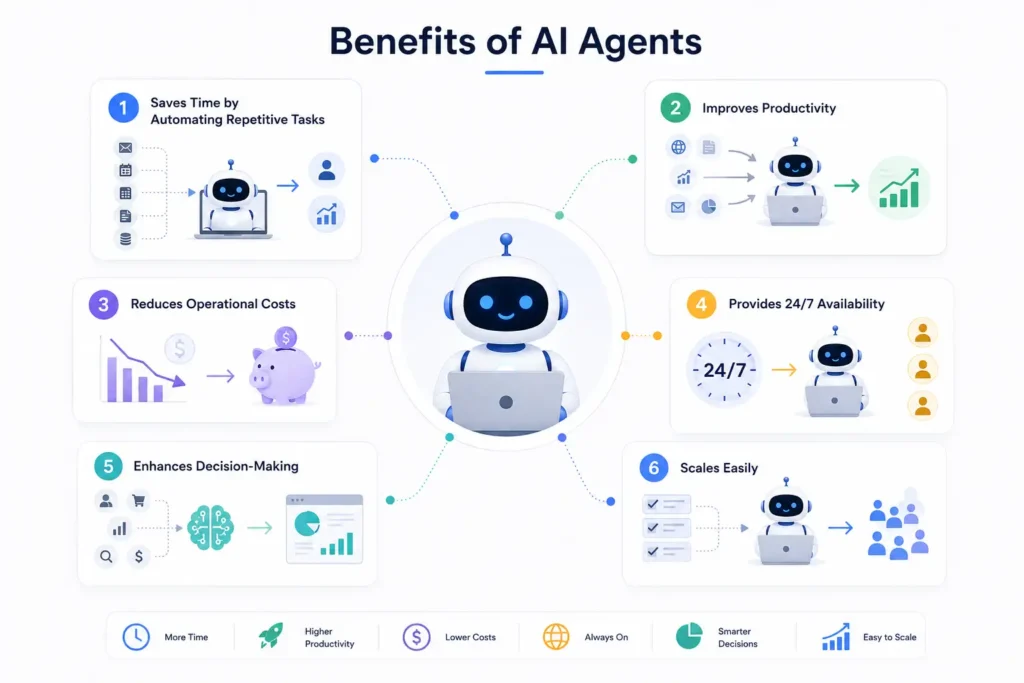
1. Saves Time by Automating Repetitive Tasks
Employees often spend hours each week on routine activities such as:
- Responding to emails
- Scheduling meetings
- Updating spreadsheets
- Generating reports
- Researching information
- Entering data into CRM systems
AI agents can perform these tasks automatically, freeing up valuable time for strategic work.
Example
A sales AI agent can:
- Find new leads
- Enrich contact details
- Draft personalized outreach emails
- Update the CRM
- Schedule follow-ups
—all without manual intervention.
2. Improves Productivity
Because AI agents can work continuously without fatigue, they significantly increase productivity.
Instead of switching between multiple applications, employees can assign a goal to an AI agent and let it handle the execution.
Example
Rather than manually researching 100 competitors, an AI agent can:
- Visit websites
- Collect pricing
- Analyze features
- Compare offerings
- Generate a summary report
in a fraction of the time.
3. Reduces Operational Costs
Hiring additional employees to manage repetitive processes can be expensive.
AI agents reduce operational costs by automating tasks such as:
- Customer support
- Document processing
- Invoice generation
- Data entry
- Workflow management
Businesses can scale operations without proportionally increasing headcount.
4. Provides 24/7 Availability
Unlike human employees, AI agents don’t require breaks or fixed working hours.
They can:
- Respond to customer inquiries
- Monitor systems
- Process requests
- Generate reports
- Execute workflows
around the clock.
This makes them particularly valuable for global businesses serving customers across different time zones.
5. Enhances Decision-Making
AI agents can analyze large volumes of data much faster than humans.
Instead of relying on intuition alone, businesses can make data-driven decisions based on:
- Customer behavior
- Sales trends
- Website analytics
- Market research
- Financial reports
Example
A retail AI agent analyzes purchasing patterns and recommends which products should be restocked before inventory runs low.
6. Scales Easily
As businesses grow, workloads increase.
AI agents can handle thousands of simultaneous tasks without the need to hire and train additional staff.
Examples include:
- Managing customer inquiries
- Processing support tickets
- Monitoring campaigns
- Generating reports
- Handling repetitive workflows
Challenges and Limitations of AI Agents
Although AI agents offer significant advantages, they are not perfect. Understanding their limitations helps businesses deploy them responsibly and effectively.
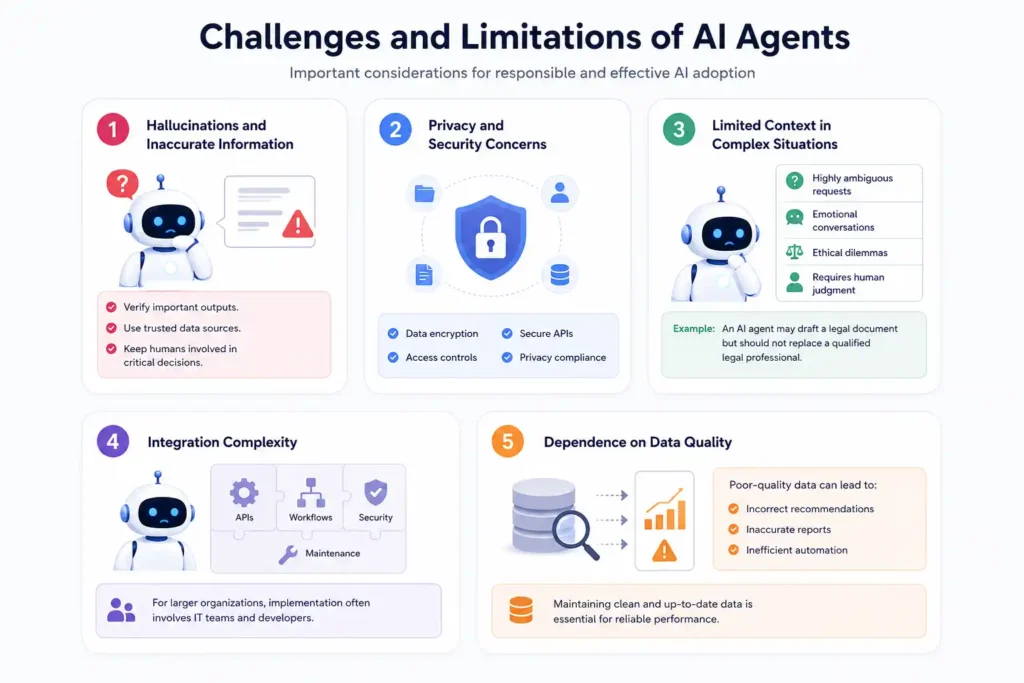
1. Hallucinations and Inaccurate Information
AI agents can occasionally generate incorrect or misleading information, especially when dealing with incomplete or ambiguous data.
Best Practice
- Verify important outputs.
- Use trusted data sources.
- Keep humans involved in critical decisions.
2. Privacy and Security Concerns
AI agents often process sensitive information such as:
- Customer records
- Financial data
- Internal documents
- Business communications
Organizations must implement:
- Data encryption
- Access controls
- Secure APIs
- Compliance with privacy regulations
3. Limited Context in Complex Situations
Although AI agents have advanced reasoning capabilities, they may still struggle with:
- Highly ambiguous requests
- Emotional conversations
- Ethical dilemmas
- Situations requiring human judgment
Example
An AI agent may draft a legal document but should not replace a qualified legal professional.
4. Integration Complexity
Connecting AI agents with multiple business systems can require:
- API integrations
- Workflow design
- Security configuration
- Ongoing maintenance
For larger organizations, implementation often involves IT teams and developers.
5. Dependence on Data Quality
AI agents are only as effective as the data they receive.
Poor-quality data can lead to:
- Incorrect recommendations
- Inaccurate reports
- Inefficient automation
Maintaining clean and up-to-date data is essential for reliable performance.
Popular AI Agent Use Cases
AI agents are being adopted across industries to automate complex workflows and improve efficiency.
Here are some of the most common applications.
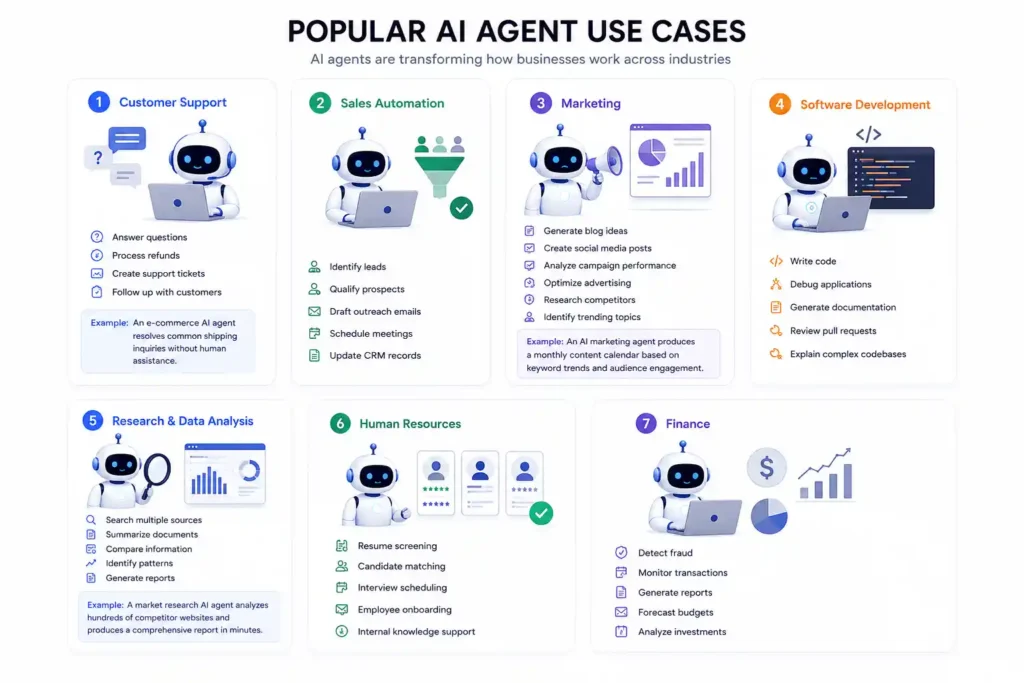
Customer Support
AI agents can:
- Answer customer questions
- Retrieve order information
- Process refunds
- Escalate complex issues
- Create support tickets
- Follow up with customers
Example
An e-commerce AI agent resolves common shipping inquiries without human assistance.
Sales Automation
Sales AI agents help teams by:
- Identifying leads
- Qualifying prospects
- Drafting outreach emails
- Scheduling meetings
- Updating CRM records
This allows sales representatives to focus on closing deals.
Marketing
Marketing AI agents can:
- Generate blog ideas
- Create social media posts
- Analyze campaign performance
- Optimize advertising
- Research competitors
- Identify trending topics
Example
An AI marketing agent produces a monthly content calendar based on keyword trends and audience engagement.
Software Development
Developers use AI agents to:
- Write code
- Debug applications
- Generate documentation
- Review pull requests
- Explain complex codebases
Research and Data Analysis
AI agents accelerate research by:
- Searching multiple sources
- Summarizing documents
- Comparing information
- Identifying patterns
- Generating reports
Example
A market research AI agent analyzes hundreds of competitor websites and produces a comprehensive report in minutes.
Human Resources
HR teams use AI agents for:
- Resume screening
- Candidate matching
- Interview scheduling
- Employee onboarding
- Internal knowledge support
Finance
Financial AI agents can:
- Detect fraud
- Monitor transactions
- Generate reports
- Forecast budgets
- Analyze investments
Industries Using AI Agents
AI agents are no longer limited to the technology sector. Organizations across almost every industry are adopting them to improve efficiency, reduce costs, and enhance customer experiences.
| Industry | Common AI Agent Applications |
|---|---|
| Healthcare | Patient support, appointment scheduling, medical documentation |
| Finance | Fraud detection, investment analysis, risk management |
| Retail & E-commerce | Product recommendations, inventory management, customer support |
| Education | Personalized tutoring, grading assistance, administrative automation |
| Manufacturing | Predictive maintenance, quality control, supply chain monitoring |
| Logistics | Route optimization, shipment tracking, warehouse automation |
| Marketing | Campaign management, SEO, content generation, analytics |
| Human Resources | Recruitment, onboarding, employee support |
| Real Estate | Lead qualification, property recommendations, appointment scheduling |
| Legal | Document review, contract analysis, legal research |
Popular AI Agent Frameworks
AI agent frameworks provide the building blocks for creating intelligent systems that can reason, plan, use tools, and complete tasks autonomously. Instead of developing everything from scratch, developers use these frameworks to accelerate the development of AI-powered applications.
Below are some of the most popular AI agent frameworks in 2026.
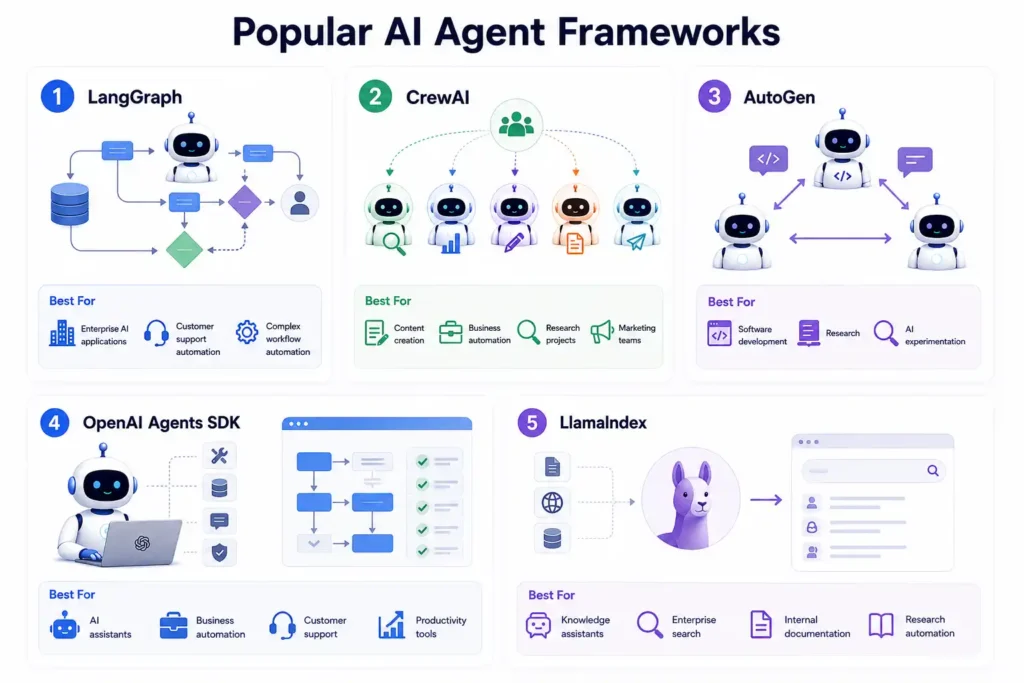
1. LangGraph
LangGraph is designed for building stateful, multi-step AI agents. It extends language model workflows by allowing developers to create graphs where agents can reason, make decisions, and revisit previous steps when necessary.
Key Features
- Stateful workflows
- Multi-agent orchestration
- Memory support
- Human-in-the-loop capabilities
- Tool integration
- Conditional branching
Best For
- Enterprise AI applications
- Research agents
- Customer support automation
- Complex workflow automation
Pros
- Highly flexible
- Excellent for long-running workflows
- Strong community support
Cons
- Steeper learning curve for beginners
2. CrewAI
CrewAI focuses on multi-agent collaboration, where multiple AI agents work together as a team, each handling a specialized role.
Example
A content marketing team could include:
- Research Agent
- SEO Agent
- Writer Agent
- Editor Agent
- Publisher Agent
Each agent contributes to the overall workflow.
Best For
- Content creation
- Business automation
- Research projects
- Marketing teams
Pros
- Easy role assignment
- Modular architecture
- Supports collaborative workflows
Cons
- Requires careful task planning
3. AutoGen
AutoGen enables multiple AI agents to communicate with one another to solve complex problems collaboratively.
Features
- Agent-to-agent conversations
- Tool execution
- Code generation
- Human participation
- Autonomous workflows
Best For
- Software development
- Research
- AI experimentation
4. OpenAI Agents SDK
The OpenAI Agents SDK helps developers build AI agents that can use tools, maintain context, and perform multi-step tasks.
Features
- Tool calling
- Memory
- Structured outputs
- Workflow orchestration
- Built-in safety features
Best For
- AI assistants
- Business automation
- Customer support
- Productivity tools
5. LlamaIndex
LlamaIndex specializes in connecting AI agents with private and external data sources.
Common Uses
- Knowledge assistants
- Enterprise search
- Internal documentation
- Research automation
Strengths
- Retrieval-Augmented Generation (RAG)
- Data indexing
- Knowledge management
| Framework | Best For | Difficulty | Multi-Agent | Memory | Tool Support |
|---|---|---|---|---|---|
| LangGraph | Enterprise workflows | Advanced | Yes | Yes | Excellent |
| CrewAI | Team collaboration | Beginner–Intermediate | Yes | Yes | Excellent |
| AutoGen | AI collaboration | Intermediate | Yes | Yes | Excellent |
| OpenAI Agents SDK | Business automation | Intermediate | Yes | Yes | Excellent |
| LlamaIndex | Knowledge retrieval | Intermediate | Limited | Yes | Excellent |
Best AI Agent Tools in 2026
Not everyone needs to build an AI agent from scratch. Many no-code and low-code platforms allow businesses to deploy AI agents quickly.
Below are some of the most popular AI agent tools available today.
1. ChatGPT Agent
Best For
General productivity and knowledge work.
Features
- Web browsing
- Document analysis
- Multi-step reasoning
- Coding assistance
- Research
- Content creation
Pros
- Easy to use
- Powerful reasoning
- Supports multiple tasks
Cons
- Advanced features may require a paid plan.
2. Manus AI
Best For
Autonomous task execution.
Features
- Workflow planning
- Research
- Report generation
- Automation
Ideal Users
- Researchers
- Consultants
- Analysts
3. Genspark AI
Best For
Research and knowledge discovery.
Features
- Information gathering
- AI-generated summaries
- Interactive knowledge pages
4. n8n AI Agent
Best For
Workflow automation.
Features
- Connects hundreds of apps
- AI-powered automation
- Custom workflows
- API integrations
Common Use Cases
- CRM updates
- Email automation
- Slack notifications
- Data synchronization
5. Lindy
Best For
Business assistants.
Features
- Meeting scheduling
- Email management
- Customer communication
- Task automation
6. Relevance AI
Best For
Business process automation.
Features
- Multi-agent workflows
- AI dashboards
- Business analytics
- Customer support automation
AI Agent Tool Comparison
| Tool | Best For | No-Code | Business Use | Multi-Step Tasks |
|---|---|---|---|---|
| ChatGPT Agent | Productivity | Yes | Excellent | Yes |
| Manus AI | Research | Yes | Excellent | Yes |
| Genspark AI | Knowledge discovery | Yes | Good | Yes |
| n8n AI Agent | Workflow automation | Yes | Excellent | Yes |
| Lindy | Executive assistance | Yes | Excellent | Yes |
| Relevance AI | Business automation | Yes | Excellent | Yes |
How to Choose the Right AI Agent
Before selecting an AI agent or framework, evaluate your needs.
Ask yourself:
- What tasks do I want to automate?
- Do I need coding knowledge?
- Which tools should the AI integrate with?
- Will multiple people use the agent?
- Does it need long-term memory?
- What is my budget?
- How important are security and compliance?
Choosing the right solution depends on your goals, technical expertise, and business requirements.
How Businesses Can Use AI Agents
AI agents are no longer limited to large enterprises. Thanks to no-code platforms and affordable AI services, businesses of all sizes can automate repetitive work, improve customer experiences, and boost productivity.
Below are some of the most practical ways organizations are using AI agents today.
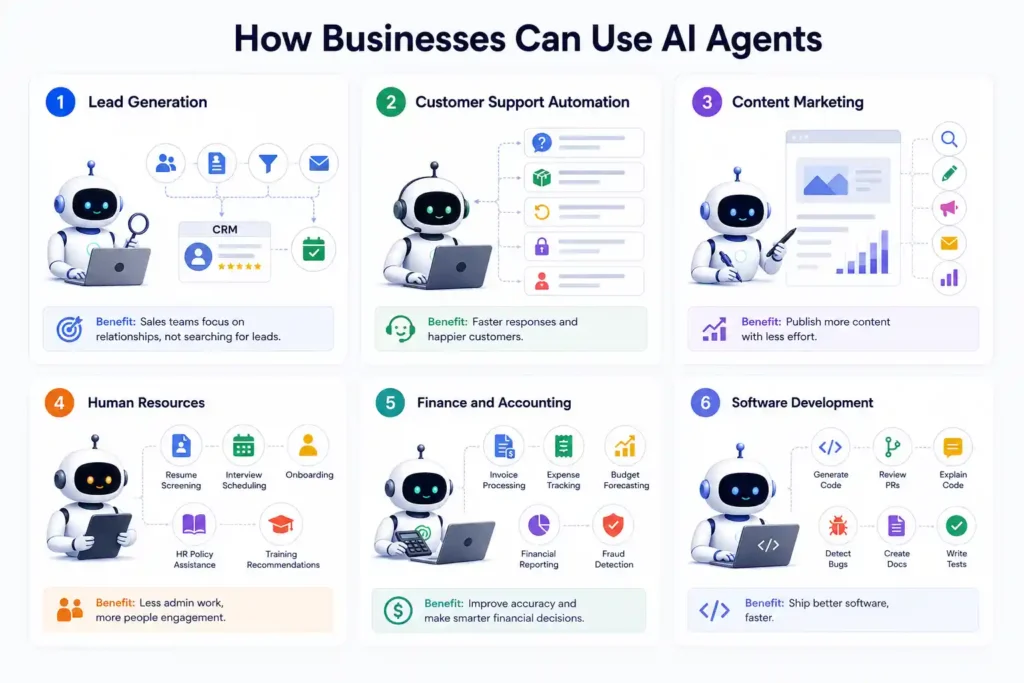
1. Lead Generation
Finding and qualifying potential customers is often time-consuming. AI agents can automate much of this process.
What an AI Agent Can Do
- Research potential customers
- Find contact information
- Qualify leads based on predefined criteria
- Enrich CRM records
- Draft personalized outreach emails
- Schedule follow-up reminders
Business Benefit
Sales teams spend less time searching for leads and more time building relationships and closing deals.
2. Customer Support Automation
Many customer questions are repetitive, making them ideal for AI agents.
Common Tasks
- Answer FAQs
- Track orders
- Process returns
- Reset passwords
- Escalate complex issues
- Follow up after support interactions
Business Benefit
Customers receive faster responses, while support teams can focus on complex cases.
3. Content Marketing
AI agents can support marketing teams by automating content planning and production.
Examples
- Keyword research
- Blog outline generation
- Social media content creation
- Email campaign drafting
- Competitor analysis
- Content performance reporting
Business Benefit
Marketing teams can publish content more consistently without sacrificing quality.
4. Human Resources
HR departments can use AI agents to streamline recruitment and employee management.
Applications
- Resume screening
- Interview scheduling
- Employee onboarding
- HR policy assistance
- Training recommendations
Business Benefit
Recruiters spend less time on administrative work and more time engaging with candidates.
5. Finance and Accounting
AI agents can simplify financial operations by automating routine tasks.
Examples
- Invoice processing
- Expense tracking
- Budget forecasting
- Financial reporting
- Fraud detection
Business Benefit
Finance teams reduce manual effort while improving reporting accuracy.
6. Software Development
Development teams use AI agents throughout the software lifecycle.
Tasks
- Generate code
- Review pull requests
- Explain code
- Detect bugs
- Create documentation
- Write automated tests
Business Benefit
Developers spend more time solving complex problems and less time on repetitive coding tasks.
The Future of AI Agents
AI agents are evolving rapidly, and their capabilities are expected to expand significantly over the next few years. Rather than replacing humans, they are increasingly being designed to work alongside people, handling repetitive tasks while supporting better decision-making.
Here are some trends shaping the future of AI agents.
Multi-Agent Collaboration
Instead of relying on a single AI agent, organizations are beginning to use teams of specialized agents.
For example, a marketing workflow might involve:
- A research agent collecting market insights.
- An SEO agent identifying keyword opportunities.
- A writing agent drafting articles.
- An editor agent improving content quality.
- A publishing agent scheduling and distributing content.
This collaborative approach can improve efficiency and deliver higher-quality outcomes.
Smarter Reasoning
Future AI agents are expected to become more effective at:
- Breaking down complex problems.
- Evaluating multiple solutions.
- Adapting to changing situations.
- Making better decisions with less supervision.
This will make them more reliable across a wider range of business applications.
Greater Personalization
AI agents will increasingly learn from user preferences, communication styles, and past interactions.
Examples include:
- Personalized learning experiences.
- Tailored shopping recommendations.
- Customized business reports.
- Adaptive customer support.
This will help businesses deliver more relevant and engaging experiences.
Wider Enterprise Adoption
As AI technology becomes more accessible, businesses across industries are expected to deploy AI agents in areas such as:
- Operations
- Sales
- Marketing
- Human Resources
- Finance
- Customer Support
- Legal Services
Rather than replacing employees, AI agents will serve as digital teammates that handle routine work and enable people to focus on strategy, creativity, and relationship-building.
Conclusion
AI agents represent the next stage in the evolution of artificial intelligence. Unlike traditional chatbots or AI assistants that simply respond to prompts, AI agents can understand objectives, create plans, use external tools, and complete complex tasks with minimal supervision.
As organizations continue to adopt AI-driven automation, these intelligent systems are becoming valuable partners in sales, marketing, customer support, software development, finance, and many other fields. Their ability to improve productivity, reduce repetitive work, and support better decision-making makes them an important technology for businesses of all sizes.
While AI agents are powerful, they are most effective when paired with high-quality data, thoughtful workflows, and appropriate human oversight. As the technology continues to mature, AI agents are expected to become even more capable, collaborative, and deeply integrated into everyday work.
Whether you’re exploring AI for personal productivity or enterprise automation, understanding how AI agents work is an excellent first step toward leveraging their full potential.
FAQs
What is an AI agent in simple words?
An AI agent is intelligent software that can understand goals, make decisions, use tools, and complete tasks with minimal human involvement.
How does an AI agent work?
An AI agent receives input, understands the objective, creates a plan, uses available tools, performs actions, and improves through feedback or memory.
What is the difference between AI and an AI agent?
Artificial intelligence is the broader field of creating systems that can perform tasks requiring human intelligence. An AI agent is a specific application of AI that can act autonomously to achieve defined goals.
Are AI agents the same as chatbots?
No. Chatbots primarily respond to user messages, while AI agents can plan, make decisions, use external tools, and execute multi-step workflows.
Can AI agents make decisions?
Yes. AI agents evaluate information, consider possible actions, and choose the most appropriate path based on their goals and available data.
Do AI agents learn over time?
Many AI agents can improve through feedback, memory, or updated training, allowing them to provide more personalized and accurate results over time.
Which industries use AI agents?
AI agents are widely used in healthcare, finance, retail, education, software development, logistics, manufacturing, marketing, customer support, and human resources.
Can I build an AI agent without coding?
Yes. Many no-code and low-code platforms allow users to build AI agents using visual workflows and prebuilt integrations.
Are AI agents secure?
They can be secure when implemented with proper authentication, encryption, access controls, and compliance with privacy regulations. Organizations should also monitor AI outputs and protect sensitive data.
What are the best AI agent tools?
Popular options include ChatGPT Agent, Manus AI, Genspark AI, n8n AI Agent, Lindy, and Relevance AI. The best choice depends on your goals, technical requirements, and budget.